
Predict, Not Just Response
As important a role as automation has played in increasing business productivity, automation is simply a predictable and repetitive task. It does not improve or adapt its own performance, as humans do, when various aspects of the business change.
To this end, most of the current planning systems are preprogrammed to respond the same way even when conditions change and the assumptions are no longer as valid as originally assumed.
In contrast, we are now at a point where systems can adapt to changes in their environment, learn from their experiences, and get smarter by themselves the more they are used.
They can self-repair and self-improve as the world around them changes. Thus, they act as autonomous vehicles to plan and operate the complex supply chains of companies without much human interaction.
A high reliance on the users to make decisions, or guide the system, has been one of the major limitations of the past approaches.
Given that with every iteration of planning, there are millions of variables to be considered, billions of versions of plans that can be produced, and thousands of variables which are constantly and dynamically changing, it is impossible for the users to come even close to constructing an optimal plan.
Therefore, almost any decision that is good enough is implemented not knowing what opportunities have been lost.
By performing a few what-if scenarios, the users make poor and inferior decisions that meet only minimal objectives of the organization. The fact is that, even if one deployed hundreds of individuals trying to find the right answer, it would still lead to suboptimal results due to the distributed nature of the data and the immense magnitude of different alternative.
An example of this can be seen in asset-intensive companies such as semiconductor manufacturing or aerospace production where billions of dollars are invested in equipment that are managed by mere spreadsheets leading to losses of tens of millions of dollars in underutilization of equipment and work in progress inventory.
Planning requires all possible constraints and, often fuzzy, objectives to be taken into account; and search for a solution that not only meets all the objectives but also optimally satisfies all the constraints.
Systems are capable of doing this in near real-time. More recently, with the use of AI search algorithms and machine learning techniques, they can have the ability to improve their own performance as they are deployed over time.
They can learn from their mistakes and use their successes to become better and better in planning as well as executing the generated plans. Over the past few years we, at Eyelit Technologies, have been working on new trends and factors that have contributed to the emergence of the next generation of supply chain planning systems including those depicted on the next page.
Today we are capable of building systems that can take the role of an apprentice that keeps learning and improving with experience.
Key Requirements for Next Generation Systems
- Supply chains are living organisms and constantly changing in character albeit slowly. Need to have the ability to dynamically measure the impact of new parameters and adjust the plans as needed
- There are underlying trends in every supply chain that are not necessarily obvious to the humans. Therefore, supply chain systems need to dynamically adapt to their environment
- Sending messages and waiting to hear from suppliers is a very slow process; and cannot deal with the complexity of the large supply chains in real-time. Need to predict what is required, and when
- KPI’s are good, but by the time you find out it might be too late. They are a measure of the past. We need to have a measure of the future. This can be done with modeling the supply chain and predicting what actions are needed proactively
- Use of spreadsheet techniques and making static assumptions about bottleneck capacities and components are outdated and leads to misleading financial conclusions, lost revenue and excessive cost
- The planning system must be able to produce the plan as well as execute it. It should take the role of a self-driving vehicle that is constantly planning, adjusting and figuring out how to get to the final destination
- Risk Resiliency—External factors can influence supply chains. Systems need to take this into account and plan to mitigate risk proactively. For example: Geopolitical factors, Acts of God, weather changes, and environmental regulations
- Systems need to communicate in Natural Languages, because users are now used to Alexa and Siri and expect the same level of convenience rather than typing, searching and reading tables on their laptops
- Response is good but prediction and prescription is better
How It Works
There are a number of AI approaches to enable smart supply chain planning systems. Such methods have been made possible by the availability of very high-speed processors and the large amount of memory to bring the thinking supply chain planning systems into the forefront of supply chain productivity. These techniques are briefly described below.
Past Data Analysis
Every model of a supply chain is built with certain underlying assumptions. Examples are supplier lead-times, equipment availability, and yield.
With the use of large data analysis method of learning, the system compares the existing model assumptions against the actual events in the supply chain on an on-going basis looking for trends and patterns.
When a significant deviation is detected in the model variables, the system performs a self-modification of the assumptions, to update the model, resulting in more accurate predictions and prescriptions.
For example, if a supplier delivery performance tends to be generally faster than the one previously assumed, then by updating the model parameters, we can enhance our responsiveness to the clients.
To this end, a self-correcting supply chain is constantly evaluating and justifying the accuracy of the model to ensure very high fidelity to the true current values.
Survival of the Fittest
In performing future demand forecasts, users try to come up with a few policies, and then select the one that best fits for a given set of data. However, there may be other combination of policy parameters that yield even better predictions.
To this end, the system experiments with other untested policies to find the superior ones for given set of attributes of each data set.
We use machine learning neural network techniques to examine the “genes” of different policies to find the data attributes as good predictors for the best policy to be used.
By mutation of these genes, we can even invent new and improved policies. We do this for every generation (a generation could be one week of planning cycle) and keep trying to find stronger policies to survive and grow and eliminate weaker ones for a given set of data attributes.
Given the number of combinations of different policies can be extremely large, humans are limited to a handful of them whereas systems can examine millions of different combinations to find the best fit to predict the future sales.
In the same manner, user inputs and their changes to the forecast are monitored and evaluated. Over time, characteristics of individuals’ inputs can be predicted.
System would recognize how optimistic or pessimistic each individual’s forecast might be; and make proper correction by adjusting the weightings on their input to make it either more or less noteworthy.
Algorithmic Inventory Planning
In a typical supply chain, the biggest mystery has been where to keep what inventory and by how much? In raw material, intermediate buffers, storage locations, finished goods, or in DC’s?
Keeping them in the later stages of the supply chain is more expensive but makes the company more responsive. However, keeping more inventory in the early stages of the supply chain is less costly but increases the lead-time to delivery.
Fortunately, there are search strategies, e.g. Gradient Descent (GD) amongst others, that can be used to optimize how much of each part to be available, and where, to satisfy the objectives of cost and responsiveness. This technique, also referred to as Multi Echelon Inventory Optimization (MEIO), is an example of prescriptive approach for improving supply chain operations.
Where the dotted line prescribes much better operating locus for any given service level and/or cost. The system is constantly working in the background to figure out the best possible curve to operate on, based on users’ objectives of cost and delivery performance.
It is used here as an example of prescriptive solutions that can yield results in minutes rather than taking a long time (days) to solve for millions of variables in a typical inventory optimization problem.
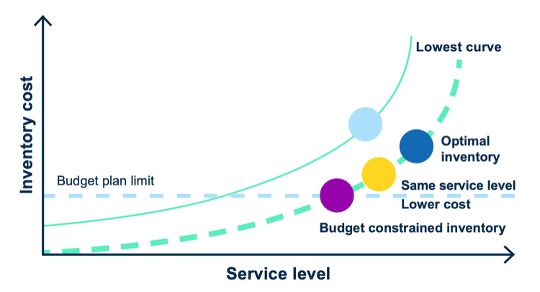
Figure 1- Best operating locus to get the lowest cost (inventory kept) for a desired service level
Learn from the Experts
Most planners have a bag of tools that are used in order to address exceptions and issues at hand. For example, when there is shortage of a material, causing late delivery of an order, they might authorize use of more expensive substitute material or preempt another order in favor of the late one, or simply call the supplier to expedite delivery.
By “observing” every time an issue arises and an action is taken by the expert, the system can remember and see if there are patterns emerging to be deployed in future instances.
An example of a possible pattern is that the planner uses the substitute material only for high priority orders. Or when the order is more than 10 days late, or both.
Mitigate Future Risks
Above predictive and prescriptive techniques are all based on how the data is behaving over time looking in the past. However, given that the system has a model of the supply chain, it is possible that this model is used to predict future patterns of behavior and future risks.
By running the model multiple times (as frequently as needed) over time, interesting and useful patterns can emerge regarding how the state of the supply chain is expected to change.
For example, too much use of a substitute material (at a higher price) to ensure on-time delivery is expected to occur too many times during summer season.
The latter is an indication that perhaps the supplier lead-times for the original material are too long or incorrect, it maybe that the actual minimum (safety) inventory is too low during summer, or it might imply that the demand for a certain product is trending much higher than before.
The system, has the capability to come up with such hypotheses and then test them, against the available information, to find out the underlying causes of higher cost or issues with the delivery performance for a certain customer(s) or product(s).
There are obviously many other risks that the system keeps monitoring, including single-sourced materials, suppliers in earthquake zones, and shortages of capacity.
The main point in this approach is that, the system picks up patterns and trends that are not necessarily visible to the user in future months or even years as opposed to just one instance of an event.
The latter can easily be corrected by the user but the trend is much harder to be detected. Furthermore, this is future data that the plan is generating. Hence, we are proactively examining the potential future risks and recommending backup plans to avoid possible undesired outcomes.
Today we are capable of building systems that can take the role of an apprentice that keeps learning and improving with experience.
Within the next decade or so, we foresee the possibility that a novice system is “planted” into any existing supply chain environment, and over time, just like a seed, it keeps growing to become an intelligent optimizing “machine,” an expert, tailor made molding into that specific supply chain.
More importantly, keeping up with all the on-going changes and getting more robust with time.
The challenges that we should be expecting are inevitably the cultural ones and the ability to trust the systems to run the multi billion dollar supply chains.
Much like today’s autonomous vehicles, there will be doubts, skepticism, and exceptions. But, none will stop the foreseeable power and speed of such systems over the limited analytical capabilities of humans.
Where does this leave us as humans? Well, it is safe to assume that we are still in charge and we are still in a position to use our creativity to make strategic decisions of much higher value that machines will have to catch up with.
Perhaps at a not so distant time in future.