
4 Most Important Manufacturing KPIs
Here are the four crucial manufacturing KPIs and their descriptions:
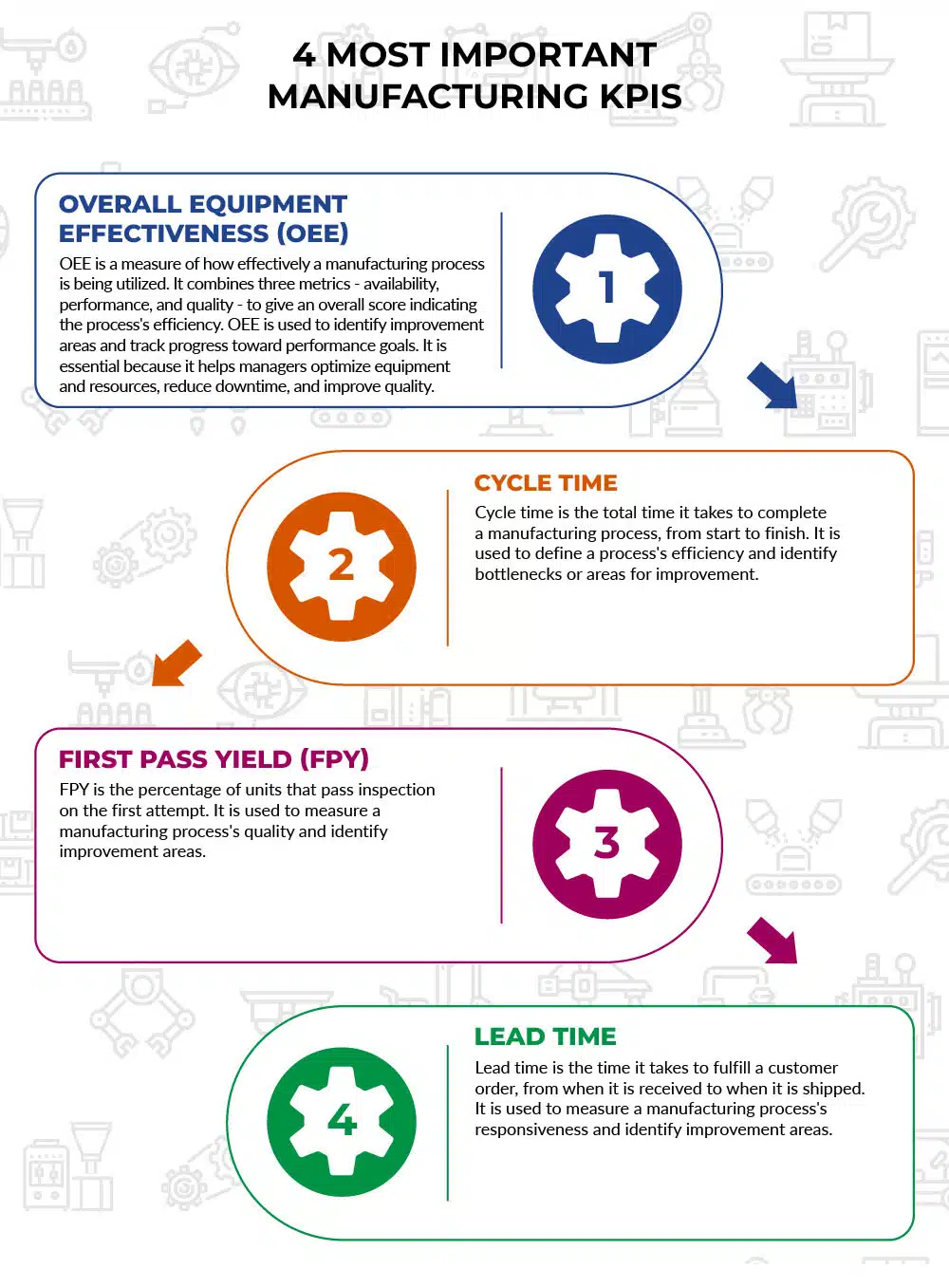
- Overall Equipment Effectiveness (OEE): OEE is a measure of how effectively a manufacturing process is being utilized. It combines three metrics – availability, performance, and quality – to give an overall score indicating the process’s efficiency. OEE is used to identify improvement areas and track progress toward performance goals. It is essential because it helps managers optimize equipment and resources, reduce downtime, and improve quality.
- Cycle Time: Cycle time is the total time it takes to complete a manufacturing process, from start to finish. It is used to define a process’s efficiency and identify bottlenecks or areas for improvement. Cycle time is necessary because it helps managers optimize the primary resources’ use, reduce waste, and increase throughput.
- First Pass Yield (FPY): FPY is the percentage of units that pass inspection on the first attempt. It is used to measure a manufacturing process’s quality and identify improvement areas. FPY is vital because it helps managers to reduce waste, improve efficiency, and increase customer satisfaction.
- Lead Time: Lead time is the time it takes to fulfill a customer order, from when it is received to when it is shipped. It is used to measure a manufacturing process’s responsiveness and identify improvement areas. Lead time is necessary because it helps managers to reduce inventory levels, improve customer satisfaction, and increase revenue.
5 Most Important Engineering KPIs
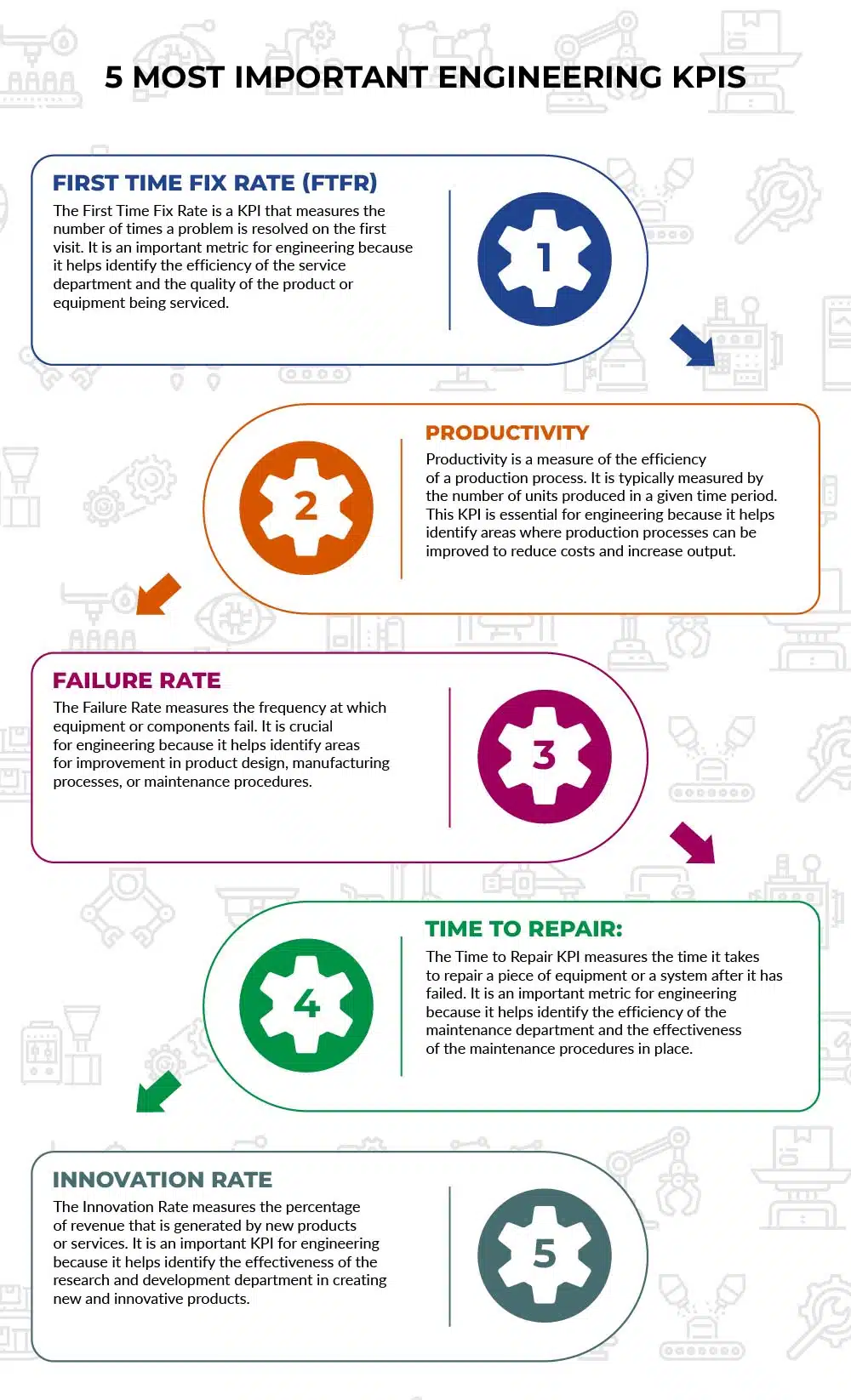
- First Time Fix Rate (FTFR): The First Time Fix Rate is a KPI that measures the number of times a problem is resolved on the first visit. It is an important metric for engineering because it helps identify the efficiency of the service department and the quality of the product or equipment being serviced.
- Productivity: Productivity is a measure of the efficiency of a production process. It is typically measured by the number of units produced in a given time period. This KPI is essential for engineering because it helps identify areas where production processes can be improved to reduce costs and increase output.
- Failure Rate: The Failure Rate measures the frequency at which equipment or components fail. It is crucial for engineering because it helps identify areas for improvement in product design, manufacturing processes, or maintenance procedures.
- Time to Repair: The Time to Repair KPI measures the time it takes to repair a piece of equipment or a system after it has failed. It is an important metric for engineering because it helps identify the efficiency of the maintenance department and the effectiveness of the maintenance procedures in place.
- Innovation Rate: The Innovation Rate measures the percentage of revenue that is generated by new products or services. It is an important KPI for engineering because it helps identify the effectiveness of the research and development department in creating new and innovative products.
Importance of Manufacturing KPIs Dashboard
Modern manufacturing software provides KPI dashboards that offer an easy-to-use interface that simultaneously presents the most relevant KPIs to production planners. The software provides a view of how the KPIs change over time and the relationship between the changes and the production goals. These dashboards are designed to be intuitive and allow the user to click on each KPI for more data.
According to an article by Manufacturing.net, these KPI dashboards can consolidate data from different sources, such as machines, sensors, and enterprise resource planning (ERP) systems. They can also monitor key metrics such as equipment utilization, production efficiency, and quality control.
Another source, IndustryWeek, adds that modern manufacturing software can leverage artificial intelligence (AI) and machine learning algorithms to provide predictive analytics that enables proactive decision-making. This solution helps production planners to optimize the manufacturing process and improve overall efficiency.
Overall, modern manufacturing software with KPI dashboards offers a comprehensive solution that allows production planners to monitor their KPIs in real-time, make data-driven decisions, and continuously improve their production process.