
If I arrive on-time or early to the airport but there is a problem with the airplane and delay in the scheduled takeoff time, does it get me to my destination sooner? Clearly the answer is No! Is it better for me to stay in the comfort of my home; and go when I know the plane is ready to take off? Or even better, find another means of getting to my destination so that I get there on time. By going to the airport at the “wrong time” and waiting I am only increasing “WIP” or waiting time and I am also contributing to airport congestion which adds to the traffic and boarding of the flights which happen to be on-time. This problem can be avoided by an intelligent algorithm, i.e. a release strategy, that can figure out exactly what the right time is for me to leave home given the traffic situation, the speed of cars, the parking time and time it takes to go through security etc. This kind of Predictive planning is ideal for releasing jobs in manufacturing, where depending on the mix of products, availability of resources and tools as well as WIP, it can decide which jobs (orders) should be released and which ones should be held back so that we meet the following three conflicting objectives optimally:
- Cycle time
- Equipment utilization
- Delivery performance
The Relationship Between Utilization, Cycle Time, and Delivery Performance as WIP Changes
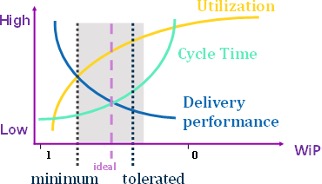
The following diagram shows the relationship between these three parameters and how they change with WIP as it increases. In a high mix environment, increase in WIP does not necessarily imply additional wait times or delay in delivery because of multiple routes and balance of allocation of jobs by the system to different work stations and equipment. The grey shaded area represents optimal region of operation where the desired objectives can be achieved. The grey area can be controlled (slide right or left) by defining preferences or the weight of each objective.
With a smart Release Strategy, we can exploit the different routings and availability of alternate resources to increase WIP without increasing cycle times and lengthening commit times.
In environments where there is a high mix of products or many configurations, we can increase the number of jobs released without increasing their waiting time by ensuring that they are balanced across different bottleneck equipment. Given the complexity of such environments where each process has many steps using many resources with sensitive set up times or batching requirements, one has to intelligently look ahead and look behind to ensure proper balance of orders re-entering the process and or entering the process with different priorities.
Integrating sequencing and job release
Unfortunately, sequencing engines have been given too much attention in order to solve such a complex problem. We feel differently and through years of R&D have concluded that unless a proper release strategy is deployed, sequencing would not be of that much value. But more importantly, Sequencing may even be detrimental in the sense that it would try to resolve issue locally not being aware of the potential issues it might be causing a few steps later!
Can you imagine being at the gate, and the airline personnel try to sequence more people than they have room for on the plane; or put you on the plane when the destination airport is not accepting incoming flights due to local weather issues?
As in our opening example, a good release strategy is aware of the right mix of products in the factory as well as the work load of each equipment, now and future, is constantly trying to balance what needs to go next such that the bottlenecks, as they are changing, will be fully utilized and at the same time keeping in mind which orders need to be ready and when for delivery. In fact, we have shown that in the presence of good release strategy, a simple FIFO is the best sequence for the resources, since jobs arrive just at the right time and no need to use elaborate sequencing techniques. In the context of our airport example, if you left your home at the right time, as you approach your gate, without much waiting, you will show your boarding pass and get into your seat for takeoff. No need to wait in line!
The ideal job release strategy
A release strategy is continuously, or periodically, monitoring the current WIP and status of the resources and their work load. Depending on the priority of the jobs, it releases them to minimize cycle times and obviously WIP inventory taking into account that bottleneck resources must be used as much as possible. In a typical assembly line, we are concerned about throughput. Thus, jobs are released at a constant and pre-determined rate. However, in high mix environment there are many different routings and alternate resources. To this end the system level-loads all resources based on the shifting bottlenecks. This approach also gives total control to the planners to decide what cycle times are acceptable for different products or customers and guide the system accordingly, as explained earlier, by sliding the grey area in the diagram back and forth. Given that the three parameters are always in conflict, by increasing WIP, equipment utilization is improved but also cycle times are increased and therefore delivery performance would suffer. However, as stated earlier, with a smart algorithm, this is not always the case since we can exploit the different routings and availability of alternate resources to increase WIP without increasing cycle times and lengthening commit times.
A release strategy is preventive approach. Sequencing, on the other hand, is a reaction to a situation that could have been prevented in the first place. There are cases such as batching or setup time reduction that sequencing can improve throughput and utilization. However, even that depends on what other items are already in the queue. If not, enough items are available for batching, then there is not much to do other than wait for more to arrive, causing an increase in WIP and cycle time. Or to go ahead and process jobs as they are resulting in under-utilization of the equipment.
Release strategy is an effective preventive method to control critical KPIs including delivery performance, utilization and of course cycle times. The methodology provides dynamic control for the management to define their objectives depending on the product (family), customer and corporate strategy as the business priorities change. For more information on how release strategy can work in your company and industry, visit Eyelit Technologies.