
Case Study Summary
Gulistan Carpet, a leading carpet manufacturer based in North Carolina, has been producing high-quality residential and commercial carpets for nearly a century. The company faced significant challenges managing complex production operations across 2,000 different colors and 70 styles while serving 4,000 retailers nationwide, resulting in lengthy three-week lead times and high inventory costs.
To address these issues, Gulistan implemented an advanced planning and scheduling system from Eyelit Technologies that enabled real-time production cycles and better coordination between their three manufacturing plants. The results were remarkable: service efficiency improved from 62% to 80%, average lead times dropped from 14 days to 8 days, and overall profitability increased through dramatic inventory reductions.
About Gulistan Carpet
Gulistan Carpet has been one of America’s leading carpet producers for nearly a century, having survived the Roaring ’20s, the Great Depression, world wars, technological evolution and shifting consumer tastes.
The challenge of providing high-end carpet products in an endless stream of design choices, as well as customizing products to satisfy individual customer orders, forced the company to make drastic changes in how it manages its production operations. Just to survive, Gulistan had to refocus the company.
After a leveraged buyout by management in 1995, Gulistan took on the challenge of being a high-quality producer in a mass market moving at Internet speed. The goal was twofold: to streamline operations and significantly enhance responsiveness to customers, and to better coordinate complex production processes and supply chain logistics to increase manufacturing productivity. Gulistan’s management has risen to the challenge.
In 1988 it implemented a custom enterprise resource planning (ERP) system from Chadwick Associates, carpet system specialists, to understand its business planning issues. But management soon realized this was not enough, and knew it had to link this information with the actual plant floor production operations at the three main plants in North Carolina.
Challenges in Textile & Carpet Industry
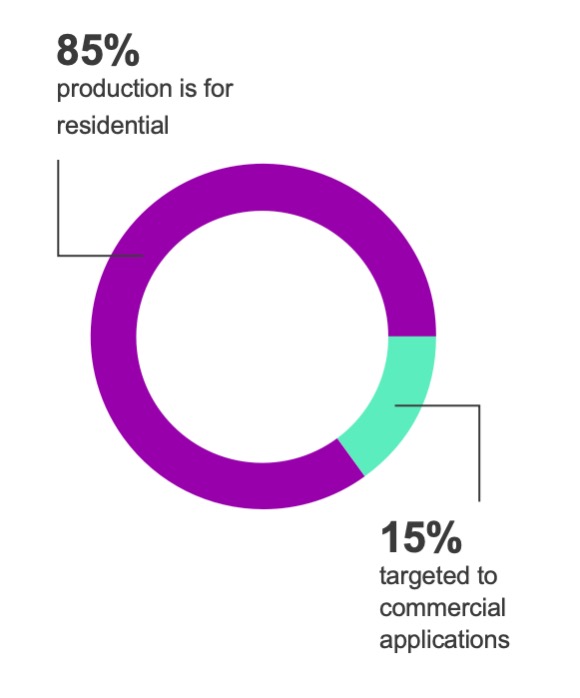
Gulistan offers consumers a broad array of high-quality carpet goods. About 85% of its production is for residential use, with the remaining 15% targeted to commercial applications. The company produces tufted carpets in nearly 2,000 different colors, in about 70 different styles and in roll widths of either 12 or 13.6 feet.
Fulfilling custom ‘cut orders’ from as many as 4,000 retailers around the country — ranging in size from Home Depot to a mom & pop store in a small town — requires managing as many as 2,350 SKUs (stock keeping units) at any one time.
“Our problem was that we had no way of knowing what our order flow would be, so we had to maintain high levels of both in-process and finished goods inventory in order to be able to respond to dealer orders as quickly as possible,” explained Richard Witt, vice president of materials management. “Even then, it took us about one week for each step in the production of a carpet order and we were getting a reputation for having relatively long lead times. Combine that with the cost related to production inefficiencies and it’s not a good business proposition.”
“Very often it would take three weeks or more to fill a customer order, and in the Internet age, when people expect instant satisfaction, that’s a long time,” he added. “We simply had to find new ways of coordinating our production to shorten those lead times.”
The Eyelit Technologies Solution
Witt and his production planning and distribution manager, Thomas Rindfleisch, selected an advanced planning and scheduling (APS) system from Eyelit Technologies, Inc., the Los Angeles-based supplier of collaborative planning software solutions.
They believed that Eyelit Technologies would provide a broader range of answers in a shorter time and would integrate well with their custom ERP system. Working with Arthur Andersen, Gulistan implemented a collaborative planning solution.
The Gulistan staff and their consultants then looked at ways to reset their supply chain ordering, based on historical customer order patterns so they could introduce just-in-time delivery of raw materials, as well as sequencing of machine operations, in their three plants. The object was to reduce the inventory of unfinished goods while eliminating production bottlenecks.
“I used to do my own forecasting based on internal reports,” Witt noted. “Now we use the Advanced Planning System (APS) to maintain a master schedule and I can do forecasting at the style level… I can provide our suppliers with a six-month general projection of what we anticipate using, with a firm commitment up to a month in advance for specific orders.”
Another production problem they resolved was the assumption that basic process steps would take a week to be finished; therefore, all production cycles would begin on a Monday and end on a Friday.
If any particular step in the process was actually completed ahead of schedule, it still had to wait for the next cycle to start at the next process step. The new APS system has allowed Gulistan to move to real-time production cycles so that no order is dependent on this cycle.
Key Production Statistics
- 85% production is for residential use
- 15% targeted to commercial applications
- The company produces tufted carpets in nearly 2,000 different colors
- 70 different styles
- Managing as many as 2,350 SKUs at any one time
- Serving 4,000 retailers around the country
“We used to do this manually,” Rindfleisch noted. “Now, doing it on the Eyelit Technologies system, each day’s orders are processed that same night and production orders are issued the next morning. This has let us take at least 24 hours, sometimes more, out of the production cycle. At the same time, it does a parts explosion for our raw material and work-in-process inventories so that we can monitor and optimize our inventory goals for real production figures, not just estimates.”
Results
The results achieved at Gulistan in just the first six months have been astonishing. Yarn production is scheduled so well now that yarn inventories have been reduced significantly and bulk continuous filament orders are processed in a more timely fashion with suppliers. Tufting operations, which can take up to a week depending on machine scheduling to handle different styles, can be predicted so much better that Witt has been able to manage inventories at this pre-dyeing stage.
Once orders are received, dyeing can now be scheduled better and in just 2-3 days, instead of a week, and finishing operations have been reduced to about two days. Production velocity has also been increased at all three plants.
“The ultimate benefit is that we’ve seen our service levels for filling orders go from 62-63% efficiency up to just over 80% efficiency… a vast improvement,” Witt said. “In just six months we’ve taken our average lead times for filling orders down from 14 days to about 8 days — nearly in half. …And because we’ve been able to dramatically reduce our inventories along the way, our profitability has been improved as well.”
Building on the outstanding initial results, Gulistan is planning on more improvements, including installation of Eyelit Technologies’ shop floor sequencer solution for better scheduling of production.
“So far we’ve only been able to assign work to standard machines so that we can reduce setup time for each process step,” Witt explained. “The APS system not only can take orders received and project production schedules based on inventory stocks and the machine time available — but it can’t tell us the sequence of machines”. Adding the shop floor sequencer will help us resolve those issues. It’ll also let us do ROI studies to decide when it makes sense to add new equipment, so we can increase production in a cost-effective way.”
All of these new systems are helping Gulistan management to not only stay competitive but to be a true leader in their industry.
Key Results Summary
- Service levels improved from 62-63% to over 80% efficiency
- Average lead times reduced from 14 days to 8 days (nearly in half)
- Dyeing process reduced from 1 week to 2-3 days
- Finishing operations reduced to about 2 days
- Yarn inventories reduced significantly
- At least 24 hours removed from production cycle
- Profitability improved due to reduced inventories
- Production velocity increased at all three plants