
SIOP definition
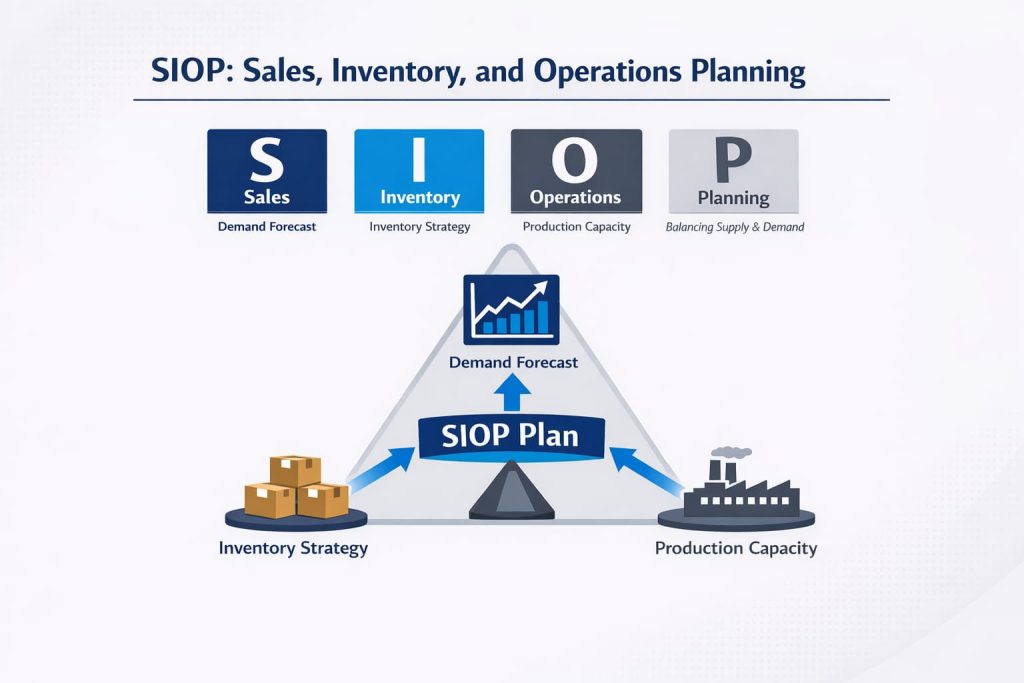
The Sales, Inventory, and Operations Planning (SIOP) definition is a manufacturing process that creates a single coordinated plan that aligns the demand forecast, inventory strategy, and production capacity before manufacturing begins.
Let’s look at these more closely:
- Demand forecast – the “Sales” in SIOP. This is a prediction of what customers will buy.
- Inventory strategy – the “Inventory” in SIOP. This is a plan for how much of each product should exist in inventory.
- Production capacity – the “Operations” in SIOP. Production capacity is a part of operations strategy. The production capacity helps factories plan how much they can produce.
APICS Definition of SIOP
An alternate definition of SIOP provided by APICS/ASCM is:
“A process to develop tactical plans that provide management the ability to strategically direct its businesses to achieve competitive advantage on a continuous basis by integrating customer-focused marketing plans for new and existing products with the management of the supply chain.”
4 symptoms of an ineffective SIOP process
The sales teams make demand forecasts, the supply chain teams manage inventory, and the operations teams create production plans based on predicted production capacity.
A formal SIOP process is needed to synchronize these 3 functions and coordinate the actions of the 3 responsible teams.
Without a functional SIOP process, the 3 functions will get out of sync and result in the following 4 common problems:
- Inventory imbalance occurs when production continues despite a shift in demand.
- Production disruption occurs when demand exceeds available production capacity or raw material supplies.
- Poor customer service results from orders not being fulfilled reliably.
- Inaccurate financial plans due to a divergence between forecasts and actual operational performance.
3 benefits of SIOP
A SIOP process brings all these inputs together into one balanced plan. Demand forecasts are reviewed, inventory targets are evaluated, and manufacturing capacity is tested to determine whether the business can supply what the market is expected to purchase.
When implemented effectively, companies using an SIOP process gain three important advantages:
1. Customer demand can be met more reliably
Ultimately, the objective of SIOP is to assure that manufacturers can deliver what customers want to purchase. By integrating demand forecasts with reasonable production plans and inventory management strategies, companies can reduce their exposure to:
- stockouts
- delayed shipments
- backorders
Sales teams have the assurance that the company will meet its commitments, and the operations teams will have knowledge of impending demand changes well before such changes affect production.
2. Inventory levels are better controlled
Inventory provides the buffer between demand variability and production capacity. Without integrated planning, companies will generally find themselves holding too much inventory on some products and too little on other products. In SIOP, inventory target values are evaluated alongside forecasted demand and supply capability. Thus, organizations can plan to hold inventory where it supports customer service and avoid inventory that is not necessary, which may tie up cash and occupy warehouse space.
3. Production schedules become more stable
When changes occur to demand forecasts or when capacity limits have been identified late in the process for manufacturing schedules, volatility can be expected. SIOP reduces this volatility by allowing forecasting of future demand to be tested against real-world production constraints prior to finalizing schedules.
The operations team can identify potential bottlenecks, potential labor issues, or supplier risk early in the planning cycle. As a result, production plans tend to change less often, equipment usage improves, and there are fewer last-minute schedule adjustments made in factories.
SIOP vs S&OP
Sales and Operations Planning (S&OP) is the widely recognized cross-functional planning process used to align demand forecasts with supply capabilities and financial objectives.
Industry organizations such as APICS define S&OP as:
“Function of setting the overall level of manufacturing output (production plan) and other activities to best satisfy the current planned levels of sales (sales plan and/or forecasts), while meeting general business objectives of profitability, productivity, competitive customer lead times, etc., as expressed in the overall business plan.”
Although inventory has always been considered as an important component in the overall supply/demand balance in sales and operations planning (S&OP), most companies evaluate their inventory goals, backlogs, and service levels as they develop their production plan.
SIOP is often used interchangeably with S&OP, although some organizations use the term to emphasize the explicit role of inventory planning alongside demand and supply balancing.
In simpler terms:
- S&OP – The cross-functional process that balances the demand, supply and financial planning.
- SIOP – A term that may be used to draw attention to the inventory strategy as it relates to the integrated planning process described by S&OP.
How SIOP works – 5 step SIOP process
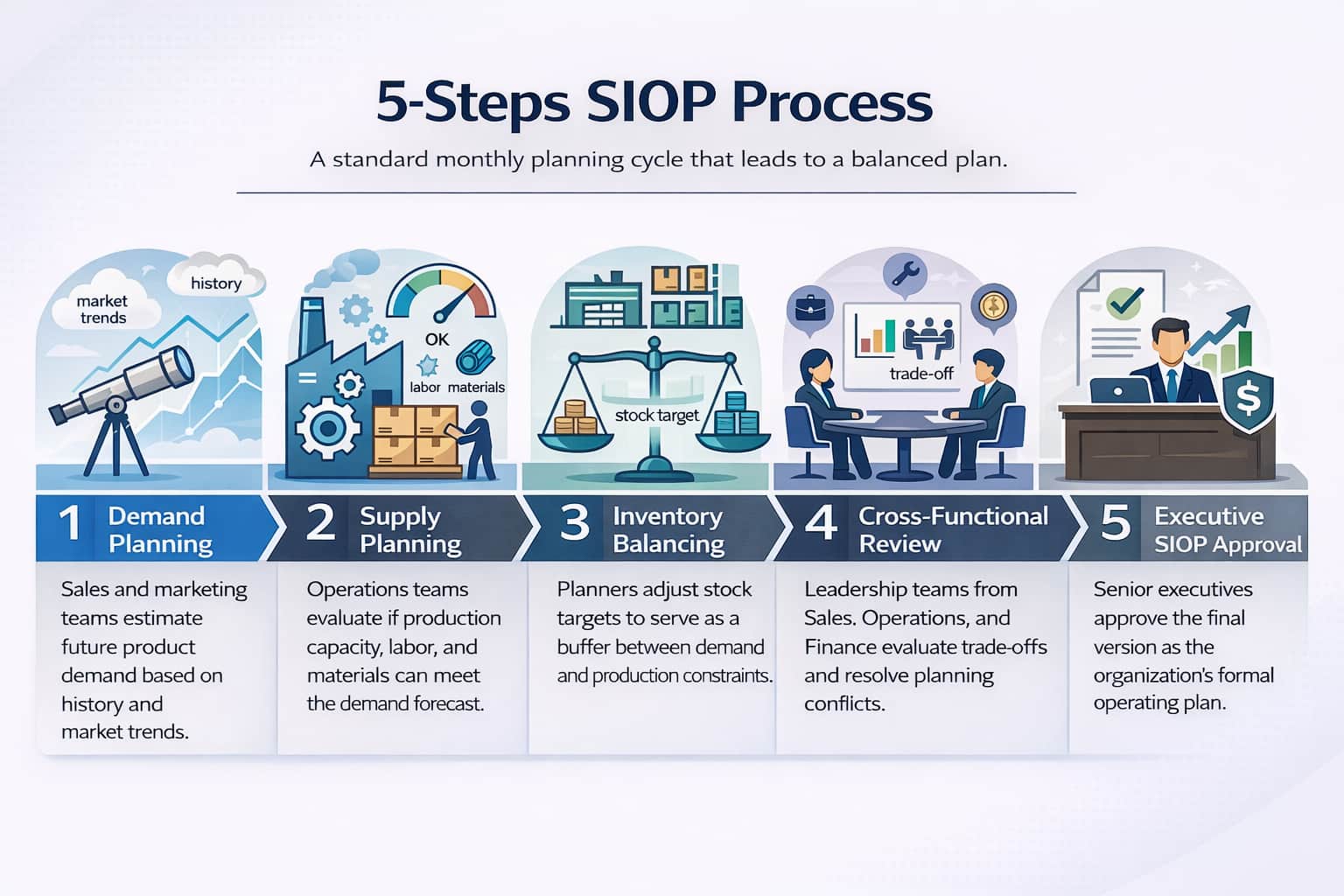
The SIOP process adheres to a standard monthly planning cycle. Each of the 5 phases of the SIOP process is a progressive refinement of assumptions about both demand and supply. This process ultimately leads to a balanced plan.
1. Demand Planning
The first phase of the SIOP process begins with an update of a demand forecast. Sales teams, marketing groups, and demand planners look at past sales history, current orders, promotions, and market trends to estimate future demand for products.
Many forecasting tools exist within ERP systems and/or specialized demand planning software to help during this phase. The purpose of this phase is to develop an accurate projection of customer demand for the upcoming planning periods.
2. Supply Planning
Once the demand forecast has been developed, the operations team evaluates whether their production capabilities and resources can meet the demand forecast. This evaluation includes:
- production capacity
- labor availability
- material supply constraints
- inventory levels
- supplier lead times
APS systems are commonly used to model production scenarios and assess whether supply can meet the demand forecast.
If the demand forecast exceeds available capacity, the planners must consider alternative options such as using overtime, sub-contracting, reducing inventory levels, or revising the demand forecast.
3. Inventory Balancing
Inventory is an essential part of the SIOP process. Inventory serves as a buffer between demand variability and production constraints.
Planners assess the inventory targets along with the demand and supply plans to ensure the current stock level meets the plan. If inventory levels are either too low, stockouts can occur; if inventory levels are too high, capital and warehouse space can be wasted.
By balancing inventory, the production schedule remains consistent while customer demand is met.
4. Cross-Functional Review and Decision Making
After the demand, supply, and inventory scenarios have been created, cross-functional teams review the results. Typically, the cross-functional teams consist of:
- Sales leadership
- Operations management
- Supply chain planners
- Finance teams
The cross-functional teams evaluate trade-offs between customer service, inventory investment, and manufacturing capacity.
If there are conflicts – i.e., demand exceeds capacity – executive-level decisions are made to adjust the plan.
5. Executive SIOP Approval
The last phase of the SIOP process involves executive-level leadership reviewing the combined plan and approving it as the organization’s formal operating plan for the upcoming period.
Once approved, the operational systems, such as ERP scheduling modules and manufacturing execution systems (MES), operate based upon that plan.
SIOP vs S&OE
Another process that is often confused with SIOP is Sales and Operations Execution (S&OE).
While SIOP addresses long-term planning (typically, several months), S&OE addresses the short-term execution of the manufacturing operation.
SIOP develops the operational plan for manufacturing to execute; S&OE monitors the execution of the plan on a day-to-day basis and adjusts the short-term plan when unexpected disruptions occur.
Examples of S&OE adjustments include:
- Moving inventory to satisfy emergency orders
- Revising production schedules to accommodate equipment failures
- Addressing supplier delay or sudden spikes in demand
In simple terms, SIOP determines the plan, and S&OE determines how the plan is executed from day to day.
Written by Alex Shapoval